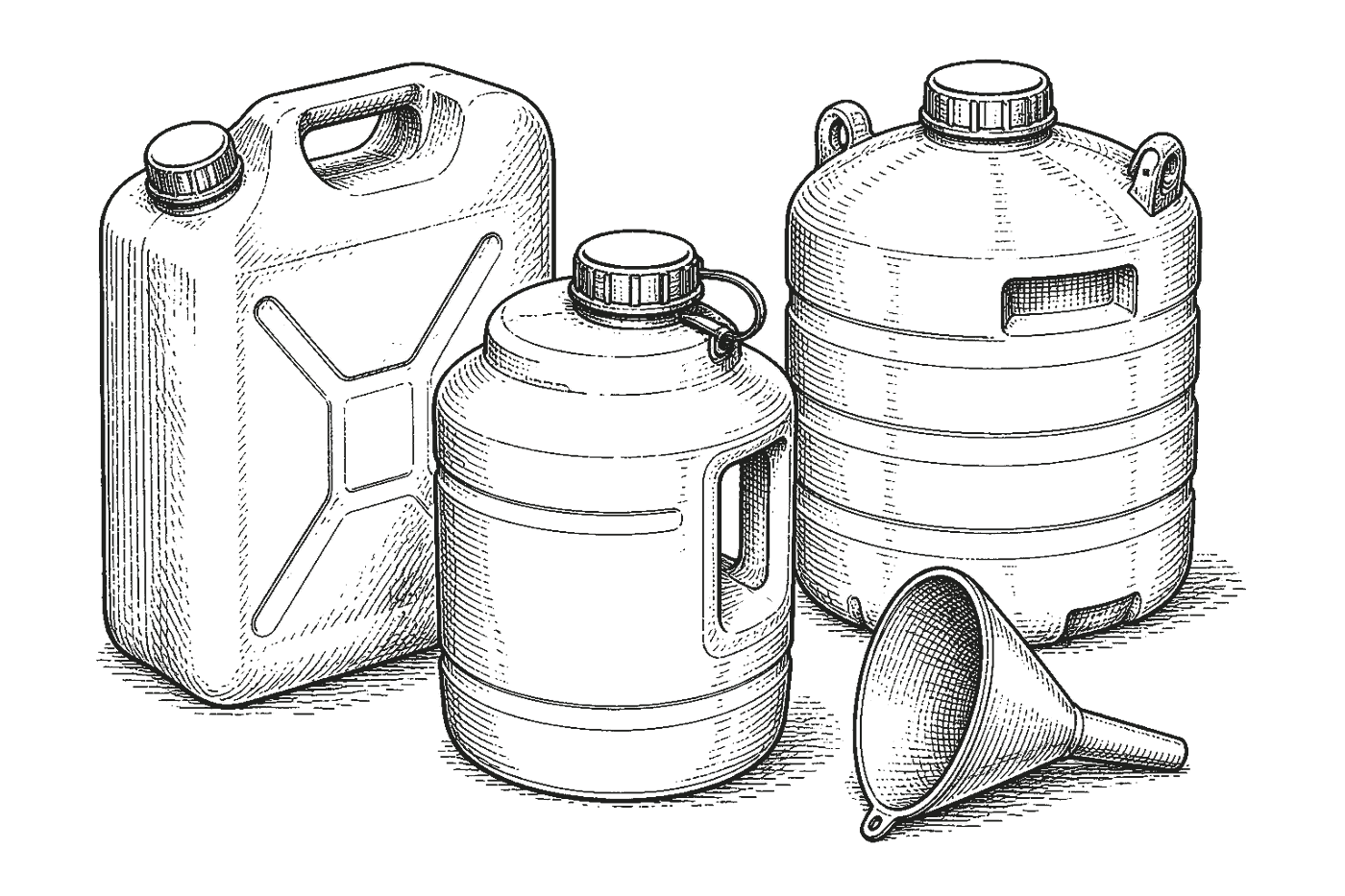
Thirty days of water sounds like a lot until you do the math, then it sounds like a closet. Households that try this usually fail in one of three ways: they store too little, they store it in the wrong plastic, or they forget it until the water is no longer something they would drink.
If you also keep food, treat water as the first layer. Food without water is a harder problem than it looks. Pair this with how to store 90 days of food once the jugs are in place.
How much 30 days actually is
The floor is one gallon per person per day for drinking and cooking. That covers drinking, coffee or tea, and the water that goes into rice, pasta, oatmeal, and soup. It does not cover dishes, laundry, flushing, or a real wash-up.
For two adults, thirty days at that floor is 60 gallons. Add a child and you are at 90. If anyone is nursing, working outside, or sick, plan above the floor.
Washing is a separate pile. If you intend to wash hands, faces, and a few dishes, add at least another half gallon to a gallon per person per day. That is how 60 gallons becomes 90 or 120 without anyone being wasteful. For a method that uses little water well, see how to wash up without running water.
Write the number down before you buy containers. Two adults, drinking and cooking only: 60 gallons. Two adults who will also wash: 90 to 120. Pets count. A large dog can add a gallon a day.
Do not store "a few cases of bottles and we'll figure it out." Bottled water is a fine top-up. It is a poor primary store because the volume is small, the plastic is thin, and the cases wander into the car and never come back.
Containers that hold and containers that fail
Use food-grade containers. Non-food plastic can leach, and you will not smell the problem until the water has sat for months.
Opaque is better than clear. Light grows algae. If the only food-grade jugs you can get are translucent, box them or keep them in a dark closet. A cardboard box around a clear jug is not pretty and it works.
Five-gallon jugs with a decent cap are the usual unit. They weigh about 40 pounds full, so do not buy a size you cannot lift. Smaller 1-gallon and 2.5-gallon jugs are easier to rotate through the kitchen. A mix is fine: big jugs for bulk, smaller ones you will actually use.
Do not use milk jugs. The plastic is thin, the caps leak, and leftover milk protein is a biology experiment. Juice jugs have the same problem if they held anything with sugar.
Do not reuse a container that held fuel, soap, pesticides, or automotive fluid. Rinsing does not make that plastic food-grade.
Wash new containers with dish soap, rinse until there is no film, then rinse once more with a little treated water before the real fill. Caps and gaskets get the same wash. A dirty cap ruins a clean jug.
If you use a barrel, it still has to be food-grade and food-use only, and you need a way to get water out without dunking a dirty cup.
Treat it before it sits
Municipal tap water that you would drink today is the easiest fill. Run the cold tap until it is cold, fill the jug, cap it tight. If your city uses chlorine or chloramine, that residual helps the water sit. You do not need to add anything else for a normal tap fill.
Well water is a different case. If you would not drink it untreated from the tap, do not store it untreated. Get it tested, or treat it as source water before it goes in the jug. Storage is not treatment.
If you are filling from a creek, a rain barrel, or a questionable well, treat it first. How to filter and purify creek water covers settle, boil, chemical contact time, and what a filter does and does not do. Do not invent a bleach recipe from memory. If you use unscented household bleach at all, follow current CDC and EPA emergency guidance and the label. We are not dosing from here.
Boiled water should cool, covered, before it goes into storage jugs. Leave a little headspace so the jug can expand with temperature. Fill it, cap it, date it.
Where it lives
Cool, dark, and still. A closet on an interior wall is better than a garage that hits 100°F in July and 20°F in January. Freezing can split plastic and pop caps. Heat speeds up plastic taste and any leftover biology.
Keep jugs off concrete if you can — a board or a low shelf is enough — so you can see leaks. Do not store water next to gasoline, paint, or solvents. Plastic is not a perfect barrier.
A stack of 5-gallon jugs along the back of a spare-room closet is a normal 60-gallon store. Under a basement stair or behind the winter coats works if you can get to every jug. A pile you have to unstack the house to reach is a pile you will not rotate.
Keep a marker and tape with the jugs. If the dating supplies live in a junk drawer, the dates will not get written.
A rotation you will keep
Date every container the day you fill it. Month and year is enough. Write it on tape on the jug, not on a list you will lose.
Rotate every 6 to 12 months. Six is cleaner if the water sits in a warm place or in clear plastic. Twelve is reasonable for opaque food-grade jugs in a cool closet, filled from a treated tap.
Pour old storage water into the garden, the mop bucket, or the dog's outdoor bowl. Refill the empty jug from the tap the same day. If you wait for a special "water day," you will skip it.
Pick a month you already do something household — spring cleaning, Thanksgiving, the first hot weekend. That is water month. You do not need a spreadsheet. You need a date on the jug and a habit that empties the oldest first.
Bottled cases get the same date and the same rule. They are not exempt because the label looks official.
If a 5-gallon pour is a two-person mess, keep a clean transfer jug dedicated to that job. People skip rotation when the pour is miserable.
When a jug is wrong
Cloud, smell, or slime means dump it. Do not taste to confirm. Do not "just boil it" if the container itself is slimy. Wash or retire the jug.
A sour, plastic, or swamp smell is enough. A film on the walls is enough. Green or brown tint is enough. Floating flecks are enough.
A jug that leaked, sat in flood water, or had a loose cap is a dump. If you cannot remember when it was filled and it has been more than a year in unknown conditions, treat it as suspect. Use it to flush or clean if it looks clear; do not make it the drinking pile.
After a dump, wash the container, inspect the cap and gasket, and decide if it is still worth filling. Scratched, cloudy, or persistently smelly plastic is done. A cracked jug that still "holds most of it" is not a storage container.
Thirty days of water is dated jugs, the right plastic, a dark shelf, and a rotation you will actually do. Once that is sitting, the next skill worth having is making unknown water drinkable — how to filter and purify creek water.